
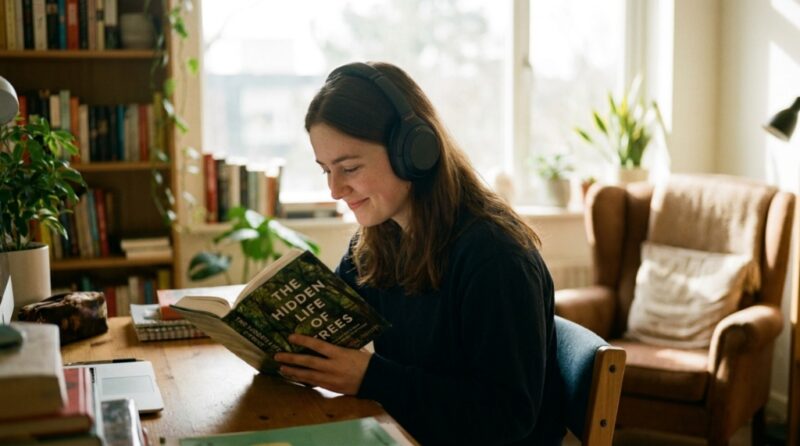
A child’s brain processes background noise with 60% more cognitive effort than an adult’s — meaning that television chatter, sibling arguments, or street traffic that adults barely notice actively drains your child’s concentration reserves before they even begin studying. Understanding how kids’ noise-cancelling headphones improve focus requires recognizing that children’s developing auditory systems lack the mature filtering capability adults take for granted — making external noise elimination through technology a genuine academic performance tool, not a luxury.
Noise-cancelling headphones for children use active noise cancellation (ANC) technology — microphones detect ambient sound waves and generate inverse sound waves that neutralize external noise before it reaches the child’s ear — creating a quiet acoustic environment that allows full cognitive resources to be directed toward learning rather than involuntary noise processing. The problem parents face? Dismissing noise cancellation as unnecessary for kids (“we studied fine without them”) while research consistently demonstrates that environmental noise reduces children’s reading comprehension by 15–25% and working memory performance by up to 30%. This guide examines exactly how study headphones for children create measurable academic benefit — and when they’re most and least appropriate for young learners.
Why Are Children More Affected by Background Noise Than Adults?
Children are more affected because their auditory cortex hasn’t fully developed the neural filtering mechanisms that adults use to automatically suppress irrelevant sounds — meaning every background noise competes equally for their attention regardless of its relevance to the task at hand.
The neuroscience behind children’s noise sensitivity:
- Immature auditory filtering: Adults unconsciously suppress 70–80% of ambient sound through top-down neural processing. Children under 13 can only suppress 30–50% — meaning 2–3x more irrelevant sound reaches their conscious attention, fragmenting focus on study material.
- Working memory competition: Every sound a child processes consumes working memory capacity — the same limited cognitive resource needed for reading comprehension, math problem-solving, and information retention. Background noise literally steals the brain power needed for learning.
- Auditory figure-ground separation: The ability to isolate one sound (teacher’s voice, reading text in inner monologue) from background noise develops gradually through childhood. Children under 10 struggle significantly with this separation — making quiet environments disproportionately beneficial for them compared to adults.
- Stress response activation: Unpredictable or loud environmental noise triggers mild stress responses (cortisol elevation) in children — further impairing the prefrontal cortex functions needed for concentrated study (attention regulation, cognitive flexibility, information encoding).
Research context: a 2019 study published in the Journal of Experimental Child Psychology found that 8–11-year-old children showed 22% lower reading comprehension scores in environments with moderate background noise (50–60 dB, equivalent to normal conversation) compared to quiet conditions. For children with ADHD or auditory processing difficulties, the impairment was even more pronounced — reaching 35–40% performance reduction.

How Does Active Noise Cancellation Technology Work in Kids’ Headphones?
Active noise cancellation in kids’ headphones uses external microphones to capture ambient sound, a processor to generate a mirror-image (inverse) sound wave, and speakers to play this anti-noise into the ear — effectively canceling external sounds through destructive wave interference before they reach the child’s eardrum.
ANC explained simply:
- Step 1 — Detection: Tiny microphones on the outside of each ear cup continuously sample environmental sound (traffic, voices, AC hum, sibling noise).
- Step 2 — Processing: An onboard chip analyzes the incoming sound wave and creates an exact mirror image — same frequency, same amplitude, but inverted in phase (peaks become troughs).
- Step 3 — Cancellation: The headphone speaker plays this anti-noise alongside any music or audio the child is listening to. When the original noise wave meets the inverted wave, they cancel each other — resulting in silence where noise previously existed.
- Step 4 — Continuous adaptation: The system updates hundreds of times per second, adjusting to changing noise environments in real-time (sudden loud sounds, shifting background frequencies).
What ANC cancels well for study environments:
- Consistent low-frequency sounds: AC/heater hum, refrigerator, traffic drone, airplane engines — reduced by 85–95%
- Moderate steady-state noise: coffee shop murmur, rain, washing machine — reduced by 60–80%
- Voices and speech (partially): reduced by 30–50% — voices are complex and variable, making them harder to cancel completely
What ANC doesn’t cancel well: sudden sharp sounds (door slam, clap, dog bark), high-frequency transients, and nearby direct speech. These sounds change too rapidly for the processing system to generate matching inverse waves. Passive noise isolation (physical ear cup seal) handles these better than ANC technology.
What Study Situations Benefit Most From Kids’ Noise Cancelling Headphones?
The study situations where noise cancelling headphones provide the greatest benefit are: homework in shared family spaces, studying in homes with younger siblings, reading comprehension tasks, standardized test preparation, and any focused work requiring sustained attention exceeding 15 minutes.
Situation-by-situation benefit assessment:
| Study Situation | Typical Background Noise | ANC Benefit Level | Expected Focus Improvement |
|---|---|---|---|
| Homework at kitchen table | Cooking sounds, family conversation, TV | High | 25–35% better task completion |
| Reading in living room | Sibling playing, TV, household activity | High | 20–30% better comprehension |
| Online class in shared bedroom | Sibling on their own device, outside noise | Moderate-High | 15–25% better attention |
| Test prep/timed practice | Any environmental distraction | Very High | 20–30% better accuracy under time pressure |
| Already quiet private room | Minimal — only HVAC/outside | Low-Moderate | 5–10% marginal improvement |
| Studying with music/white noise | Self-selected audio playing | Low (ANC unnecessary with audio) | Minimal additional benefit |
The highest-value use case: children studying in shared family spaces where creating a physically separate quiet room isn’t possible. Noise cancelling headphones create a “portable quiet room” that travels with the child to whatever space is available — eliminating the housing-dependent privilege of private study spaces.
Are There Risks to Using Noise Cancelling Headphones for Kids?
The primary risks are: volume-related hearing damage if not volume-limited (solvable with 85dB-capped models), social isolation if used excessively, reduced environmental awareness that could create safety concerns, and potential over-reliance that delays developing natural focus skills.
Risk-by-risk assessment and mitigation:
- Hearing damage (manageable risk): ANC itself doesn’t damage hearing — it actually protects it by eliminating the need to turn volume up to overcome background noise. However, any headphone at excessive volume (above 85dB for extended periods) can cause damage. Solution: choose headphones with built-in 85dB volume limiters. These physically prevent harmful volume regardless of source device settings.
- Social isolation (parental management needed): A child who wears headphones constantly to avoid all family interaction is using the technology as withdrawal rather than a focus tool. Solution: designate specific “headphone study time” (30–60 minute blocks) rather than allowing unlimited use. Headphones come off for meals, family time, and transitions.
- Reduced environmental awareness (context-dependent): A child in ANC headphones can’t hear smoke alarms, parent calls, or approaching vehicles as clearly. Solution: Use only in supervised indoor environments during study. Never during outdoor activities, walking near traffic, or situations requiring environmental awareness.
- Over-reliance/crutch concern (long-term consideration): Children need to develop internal focus skills that function without technology assistance. Solution: use ANC headphones as one tool among many (also teach time-blocking, minimize digital distractions, create study routines) rather than the sole focus strategy.
Expert consensus: the American Academy of Pediatrics doesn’t specifically address noise-cancelling headphones for study but recommends volume-limited headphone use at 85dB or below for no more than 2 hours continuously. Following this guideline with study-appropriate time limits creates a safe, beneficial tool without meaningful risk.
What Features Should Study-Focused Kids’ Headphones Have?
Study-focused kids’ noise-cancelling headphones need: 85dB volume limiter (non-negotiable safety), effective ANC that reduces ambient noise by at least 20dB, comfortable padding for 30–60 minute sessions, lightweight construction under 200g, and optional wired connection for devices without Bluetooth.
Feature checklist for study headphones:
- 85dB volume limiter (essential): Hardware-based limit that prevents volume from exceeding safe levels regardless of source device settings. Software-only limits can be bypassed — hardware limits cannot. Non-negotiable for any children’s headphone purchase.
- ANC effectiveness (minimum 20dB reduction): Measured noise reduction should eliminate at least 20dB of ambient sound — enough to transform a noisy household into a library-quiet environment. Check reviews for ANC effectiveness specifically, not just presence.
- Comfort for extended wear: Memory foam ear cushions, padded headband, lightweight materials. Children will reject headphones that create pressure points within 15 minutes — defeating the purpose regardless of ANC quality.
- Weight under 200g: Heavy headphones cause neck strain and headband pressure in children with smaller frames. Adult ANC headphones (250–350g) are inappropriate for children under 12. Kids-specific models prioritize lightweight construction.
- Wired + wireless option: Bluetooth for convenience, but a 3.5mm cable option for school computers, testing environments where Bluetooth isn’t permitted, and situations where the battery dies mid-study-session. Dual connectivity prevents interruption.
- Microphone for online classes: If used for virtual schooling or tutoring, a built-in microphone with decent quality eliminates the need for a separate headset. Check that the mic clearly captures the child’s voice without excessive background pickup.
- Durable construction: Children aren’t gentle with equipment. Flexible headbands that survive bending/twisting, replaceable ear cushions, and reinforced cable connections extend product lifespan beyond the typical 6 months before a child breaks fragile adult headphones.
Which Kids’ Noise Cancelling Headphones Are Best for Studying?
The best study-focused noise cancelling headphones for kids are: Puro BT2200 Plus (best volume safety + ANC), JBL JR460NC (best overall value), and BuddyPhones Cosmos+ (best comfort for younger children) — all combining effective ANC with 85dB volume limiting specifically designed for children’s ears.
- Puro BT2200 Plus ($80–$100): 85dB studio-grade volume limiter, active noise cancellation, 22-hour battery, 82% ambient noise reduction, premium build. Designed by an audiologist specifically for children’s hearing protection. Best for: serious study environments, children with sensory sensitivity.
- JBL JR460NC ($50–$70): JBL brand quality, active noise cancellation, 85dB volume cap, 30-hour battery, built-in mic for online school, lightweight (175g). Excellent ANC at the most accessible price point for kids’ headphones. Best for: everyday study use, budget-conscious families.
- BuddyPhones Cosmos+ ($60–$80): Active noise cancellation, SafeAudio volume limiting (75/85/94dB switchable), ultra-comfortable padding designed for smaller heads, foldable for travel. Best for: younger children (4–8), kids who reject uncomfortable headphones.
- Sony WH-1000XM5 (for older teens, $300+): Industry-leading ANC, but no kid-specific volume limiter — appropriate only for responsible teenagers 14+ who can manage their own volume. Not recommended for younger children without parental volume control at the device level.
How Should Parents Implement Study Headphone Use?
Implement study headphone use through structured time blocks (30–60 minutes on, 10–15 minutes off), designated study-only contexts (not entertainment default), volume verification at setup, and gradual introduction that teaches the child to associate headphones with productive focus time.
- Time structure: 30 minutes of headphone study for ages 6–9. 45–60 minutes for ages 10–13. Mandatory break between sessions (remove headphones, stretch, change activity briefly). This prevents both hearing fatigue and social isolation.
- Context limitation: Headphones are a “study tool” — not a “tune out the family” tool. Establish that ANC headphones are for homework, reading, and focused learning only. Entertainment listening (music, podcasts, games) uses regular volume-limited headphones or speakers.
- Volume check ritual: At initial setup, verify the 85dB limiter is active. Periodically ask your child to hand you the headphones while audio is playing — if you can hear audio clearly at arm’s length, volume may be set too high even within “safe” limits. Comfortable listening should be barely audible to someone holding the headphones at a distance.
- Positive association building: Don’t introduce headphones as punishment (“put these on so you stop bothering us”). Introduce as empowerment (“these help your brain focus — like a superpower tool for your study time”). Children who associate headphones with capability use them more effectively than those who associate them with isolation.

Conclusion
Noise-cancelling headphones help children focus while studying by solving a neurological reality that willpower cannot override — children’s developing brains simply cannot filter background noise as effectively as adults, and every sound that penetrates their attention steals cognitive resources from learning. Kids’ noise-cancelling headphones with proper volume limiting (85dB) create safe, quiet study environments that travel with the child regardless of household noise conditions — enabling focus in shared spaces that would otherwise fragment attention continuously.
The technology isn’t a substitute for developing internal focus skills — it’s a support tool that allows those skills to develop without the handicap of fighting environmental noise simultaneously. Choose study headphones for children that combine effective ANC with mandatory volume safety, implement structured use with time limits and context boundaries, and observe whether your child’s homework completion time decreases and comprehension quality improves. For most children studying in typical household environments, the improvement is measurable within the first week of consistent use.
If your child struggles to concentrate during homework time, background disruptions are usually the culprit. Investing in the right gear can instantly transform their study environment. However, finding the right fit depends heavily on what they are doing; for instance, if they switch from homework to gaming rewards, you might wonder which type of headphone is best for gaming to ensure they get the right balance of microphone quality and spatial audio. For pure academic focus, active noise cancellation remains the gold standard.
Frequently Asked Questions
At what age can kids use noise-cancelling headphones for studying?
Most manufacturers design kids’ ANC headphones for ages 4–5 and up, with appropriate head sizes and volume limiters. For focused study use, children benefit most from age 6+ when homework demands and attention-span expectations increase meaningfully. Under age 6, study sessions are typically short enough (10–15 minutes) that ANC provides minimal additional benefit over simply reducing household noise sources manually.
Can noise-cancelling headphones help kids with ADHD focus?
Yes — research supports meaningful benefit. Children with ADHD are disproportionately affected by environmental noise due to executive function differences that impair distraction filtering. ANC headphones reduce the external stimuli competing for their attention, allowing medication and behavioral strategies to work more effectively in the quieter environment. Many occupational therapists recommend ANC as part of a comprehensive ADHD study environment strategy.
Should kids listen to music or white noise while studying with ANC headphones?
ANC alone (silence) works best for tasks requiring language processing (reading, writing, verbal learning). Low-volume instrumental music or white noise can help for repetitive tasks (math practice, copying). Avoid lyrics during any language-based study — the brain processes sung words involuntarily, competing with the study material for language processing resources regardless of attention intent.
How long can kids safely wear noise-cancelling headphones?
With 85dB volume limiting, up to 2 hours continuously is considered safe by WHO/AAP guidelines. For study purposes, 30–60 minute blocks with 10–15 minute breaks are more effective than marathon sessions — both for hearing protection and for maintaining focus quality, which degrades after 45–60 minutes regardless of noise environment.
Do noise-cancelling headphones work without playing any audio?
Yes — ANC functions independently of audio playback. Children can wear ANC headphones with no music/content playing and simply experience reduced environmental noise. This “silence mode” is arguably the most appropriate study use — providing a quiet environment without any audio distraction competing for attention alongside study material.
Are noise-cancelling headphones better than earplugs for kids’ studying?
For most children, yes. Earplugs provide passive noise reduction (20–30dB) but are uncomfortable for extended wear, difficult for small ear canals, and can’t selectively allow teacher/parent voice through. ANC headphones offer similar or better noise reduction with superior comfort, the option to pass through voices when needed (transparency mode), and the flexibility to add study audio (white noise, instructions) when beneficial.
